Clinical Test by Japan Apollo Fitness
¡¸HUSLA¡¹Motion Analysis Graph
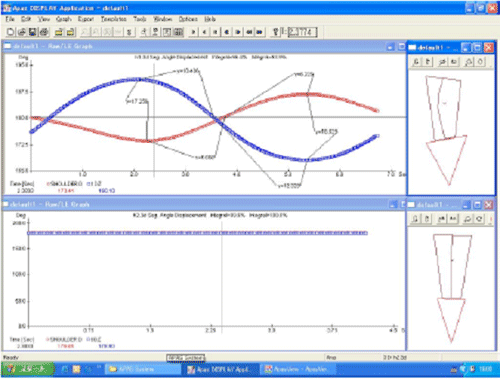
Frontal Side (view from rear) Graph depicts the shoulder movement on both sides with the line of pelvis inclined when moving left and right
|
|
 |
|
The graph above (HUSLA) shows the change shoulder (Blue) and pelvis (Red) lines in opposite directions. The relative difference between the blue and red line is caused by side inclination of the spine.
The graph below (Regular Chair) shows the overlap of shoulder (Blue) and pelvis (Red) lines at 180-degrees. In this arrangement, the displacement of each area as well as pelvic movement is significantly low.
In the graph above (HUSLA), just moving left and right slightly increases the side inflective vibration of the spine (distortion angle of shoulder line and pelvis is 17.256¡Æ (right) and 18.629¡Æ (left)) and furthermore, it enables the exercise that moves from central (line of 180¡Æ) point to the side (vertical line in the graph). (Shoulder line: right 6.66¡Æ, left 6.229¡Æ, right pelvis: 17.256¡Æ, left 18.629¡Æ.)
Side Area (view from side)
|
|
 |
|
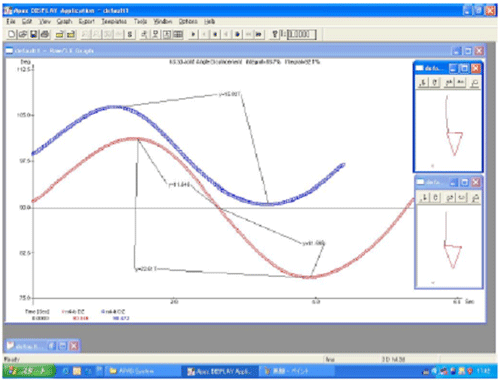
The graph indicates cross angle between pelvis and spinal area when performing back/forward exercise using ¡¸HUSLA¡¹(Red) and regular chair (Blue).
The range of motion during the back/forward movement of the center is identified as 22.617¡Æ for ¡¸HUSLA¡¹and 15.827¡Æ for a regular chair.
In addition, the graph depicting ¡¸HUSLA¡¹ shows the regulated changes in all direction. On the other hand, the regular chair was graphed above the line indicating 90¡Æ.
As a result, ¡¸HUSLA¡¹is capable of both forward bending as well as backward bending.
|
|
 |
|
|
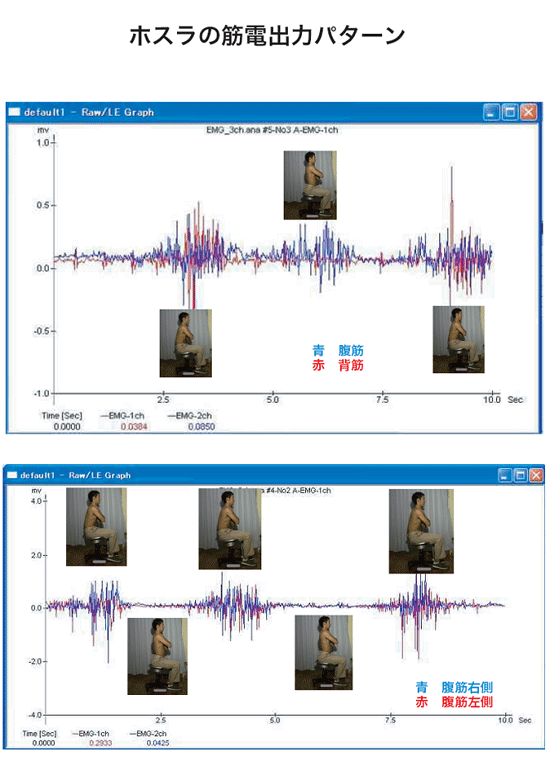
¡¸HUSLA¡¹provides excellent pelvic exercise by enabling the movement of both side bending and back/forward bending in all directions.
|
|
Japan Rehabilitation Center
Doctor ô¹ÓöÚÂßæ
|


